Choosing the Right Aircon for Your Home in Singapore
Practical 2026 buyer's guide to choosing aircon in Singapore. BTU sizing by room, inverter payback, brand reliability, tick ratings, and installation costs.

Getting the right aircon for your home directly determines your daily comfort and long-term electricity costs. A poorly sized unit forces the compressor into constant operation, inflating bills unnecessarily.
This walkthrough covers every decision in the order you need to make them, from precise BTU sizing to energy efficiency ratings and brand selection. Whether you live in an HDB flat near Jurong East or a private condo along the East Coast, the fundamentals remain the same.
BTU sizing: the most critical decision
BTU (British Thermal Unit) capacity must match the room’s square metreage exactly. Getting this wrong creates problems that no amount of servicing can fix.
Too small: The compressor runs non-stop without reaching the target temperature. Short lifespan, high bills, poor comfort.
Too large: Rapid on-off cycling prevents proper dehumidification. Clothes and walls feel clammy despite the room feeling cold.
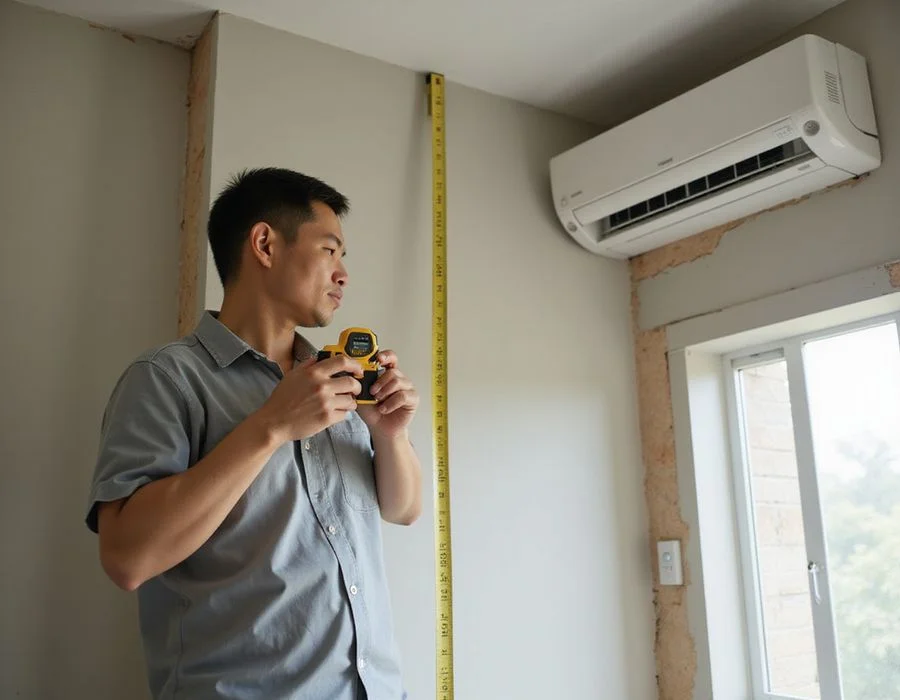
Sizing table for HDB and condo rooms
| Room type | Typical area | Recommended BTU |
|---|---|---|
| Single bedroom / study | 8-12 sqm | 9000 BTU |
| Master bedroom | 13-18 sqm | 12000-13000 BTU |
| Large master / combined bedroom | 19-24 sqm | 18000 BTU |
| Living room (small HDB) | 18-22 sqm | 18000 BTU |
| Living + dining (open-plan) | 25-35 sqm | 24000 BTU |
| Large living (condo, landed) | 35-50 sqm | 28000-30000 BTU |
Undersizing by just 20% forces the compressor to skip idle phases entirely. That single mistake can push daily energy consumption up by over 15%.
Adjust capacity for these factors
Add 15-20% for top-floor or west-facing units. Add 10-15% for rooms with extensive glass panels. Add 10% for ceilings higher than 2.6 metres, rooms with hot appliances, or regular occupancy above two people. Reduce capacity for shaded ground-floor rooms used only briefly.
A professional site survey eliminates guesswork. Generic advice based on a neighbour’s setup frequently leads to mis-sized installations.
Choosing your system type
The right configuration depends on your outdoor ledge space and how many rooms need cooling. Multi-split remains the standard for Singapore flats due to strict HDB space constraints.
Single-split (one indoor, one outdoor): Simplest setup, cheapest per BTU, fastest to install. Each room needs its own compressor, which creates ledge congestion if you have multiple rooms.
Multi-split (one outdoor, 2-5 indoor): The dominant choice for HDB and condo flats. One compressor serves multiple rooms, saving exterior space. HDB limits external installations to a maximum of two split-type condensing units, making multi-split essential for 4-room flats and above.
Window units: Rare in modern Singapore. Still used in older HDB blocks and budget rentals. Noisier, less efficient, but cheapest upfront.
Ducted / cassette (ceiling-concealed): For high-end condos, landed homes, and commercial spaces. Invisible when installed, even air distribution, but significantly higher cost and specialist installation.
Inverter vs non-inverter
Inverter technology uses a variable-speed compressor to maintain temperature without wasteful full-power cycling. For rooms used more than four hours daily, the electricity savings (30-50% less power) pay back the S$150-S$300 premium within 1-2 years.
Non-inverter still makes sense for guest bedrooms used under 30 nights annually, where the payback stretches beyond the unit’s lifespan.
See our detailed inverter vs non-inverter guide for the full comparison.
Brand selection for Singapore
The brand you choose determines replacement part availability and long-term support quality. Our iCare Aircon team groups the major brands by market positioning.
Premium reliability: Daikin (industry benchmark for durability, best parts network) and Mitsubishi Electric (equally reliable, ultra-quiet 19dB indoor units, excellent dehumidification).
Strong mid-tier: Panasonic (Nanoe air purification, good parts availability), Toshiba (best value among Japanese brands, compact condensers), and LG (strong dual-inverter technology, best smart app ecosystem).
Budget tier: Midea, Hisense (20-35% cheaper upfront, improving build quality, suitable for light-use rooms and rental properties).
For main living areas and master bedrooms, Daikin and Mitsubishi remain the safest long-term choices. Toshiba and Panasonic serve as excellent alternatives for secondary rooms. Full comparison in our best aircon brands guide.
NEA energy efficiency ratings (ticks)
The National Environment Agency issues Energy Labels rated 1-5 ticks based on the Cooling Seasonal Performance Factor (CSPF).
- 1-2 ticks: Minimum compliance. Avoid for any regularly used room.
- 3 ticks: Acceptable baseline for standard bedrooms.
- 4 ticks: Good efficiency-to-price ratio for most homes.
- 5 ticks: Premium tier that pays back within 3-4 years for heavy-use rooms.
At the current SP Group tariff of approximately 29.7 cents per kWh, a 5-tick inverter saves roughly S$145 annually versus an equivalent 3-tick model. The S$100-S$300 premium pays for itself within three years of regular use.
Features worth paying for
Genuinely useful: Self-clean mode (reduces biofilm between chemical washes), WiFi app control (pre-cool rooms remotely), motion sensors (auto-adjust when nobody is present), and Dual Barrier Coating (Mitsubishi Starmex, prevents dust adhesion).
Nice but not critical: Air purification (marginal benefit, cannot replace standalone purifiers), voice control (standard WiFi apps achieve the same result), fast-cool modes (inverters ramp naturally).
Marketing with minimal impact: “Tropical edition” labels (usually identical hardware), mold-resistant coatings (useful but still need chemical washes every 2-3 years).
Warranty considerations
Standard brand warranties in Singapore cover: compressor for 5 years (premium brands up to 10), parts for 1 year, and installer workmanship separately.
iCare Aircon installations include a 90-day workmanship warranty covering leaks, tilt, drainage, and wiring. The brand warranty runs separately on the hardware. Retain all service records, as manufacturers can void compressor warranties if yearly maintenance is skipped.
Choosing your installer
A premium aircon installed poorly will always underperform a mid-tier unit installed correctly. Key questions for any installer:
- Do you perform a physical site survey or quote from photos?
- Are your technicians BCA-trained and certified?
- What is the precise workmanship warranty period?
- Will you pressure-test refrigerant lines before commissioning?
- Do you handle HDB permit processing and the SP Services Form CS/5H?
- Do you supply Grade SS 304 stainless steel brackets for external mounting?
Our installers use SWG 22 (0.71mm) copper pipes for all new installations. Modern R32 refrigerant operates at higher pressures than older gases, making thicker piping essential for long-term reliability.
Typical 2026 all-in costs
| Configuration | Unit + install |
|---|---|
| Single-split 9000 BTU 3-tick | S$900 - S$1,400 |
| Single-split 9000 BTU 5-tick inverter | S$1,200 - S$1,800 |
| Multi-split 2-indoor (bedroom + master) | S$2,500 - S$3,800 |
| Multi-split 4-indoor (full flat) | S$4,500 - S$7,500 |
| 5-tick premium multi-split 4-indoor | S$6,500 - S$10,000 |
Budget an extra S$100-S$200 for SWG 22 copper piping upgrades across the system. Dismantling fees for old units typically run S$50-S$100.
WhatsApp us your flat type, room count, and rough dimensions for a quick ballpark figure. View our installation service details for the complete breakdown of site survey and installation scope.
Part of the Aircon Installation guide hub
← Back to the main Aircon Installation pageQuestions Answered
Frequently Asked Questions
What BTU do I need for a Singapore bedroom?
Standard HDB bedroom (9-12 sqm): 9000 BTU. Master bedroom (13-18 sqm): 12000-13000 BTU. Living room (20-30 sqm): 18000-24000 BTU. These assume average insulation and not a top-floor unit. Top-floor or west-facing rooms need 15-20% more.
Do I really need an inverter aircon?
For any room you use more than 4 hours daily, yes — the electricity savings (15-30%) pay back the price premium within 2-3 years. For a guest bedroom used 20 nights a year, non-inverter may still make sense on upfront cost.
What tick rating should I look for?
NEA ticks 1-5 show energy efficiency. Minimum 3 ticks for any bedroom use. 4-5 ticks for living rooms and heavily-used bedrooms. The price difference between 3-tick and 5-tick usually pays back within 3-4 years in electricity savings.
 LICENSED
 About the Author
Mr Chong
Founder & Licensed HVAC Technician, iCare Aircon
Mr Chong founded iCare Aircon in Jurong after more than 10 years in Singapore’s HVAC industry. He started as an apprentice technician on HDB rooftops, moved into commercial chiller work, then built iCare Aircon to offer honest, diagnostics-first aircon servicing across Singapore. He holds a BCA-licensed contractor registration, NEA-certified refrigerant handler status, and personally trains every technician on the team. Mr Chong writes these guides to answer the same questions he hears on every job call.
Related Guides
Inverter vs Non-Inverter Aircon: Is the Premium Worth It?
Inverter aircon worth the premium? 15-30% lower electricity, real payback calculations, noise and lifespan differences. Honest 2026 recommendation.
Read guide →Split vs Window vs Multi-Split Aircon: Choosing Your System
Split, window, or multi-split aircon for Singapore? Pros, cons, 2026 costs, and ideal use cases for each system type. How to match hardware to your flat.
Read guide →Best Aircon Brands for HDB and Condo Homes in Singapore
Daikin, Mitsubishi, Panasonic, Toshiba, LG compared for Singapore HDB and condo. Reliability, efficiency, parts availability, and real installation share data.
Read guide →Ready for cool, clean air — today?
Chat with iCare Aircon on WhatsApp for same-day aircon service island-wide.